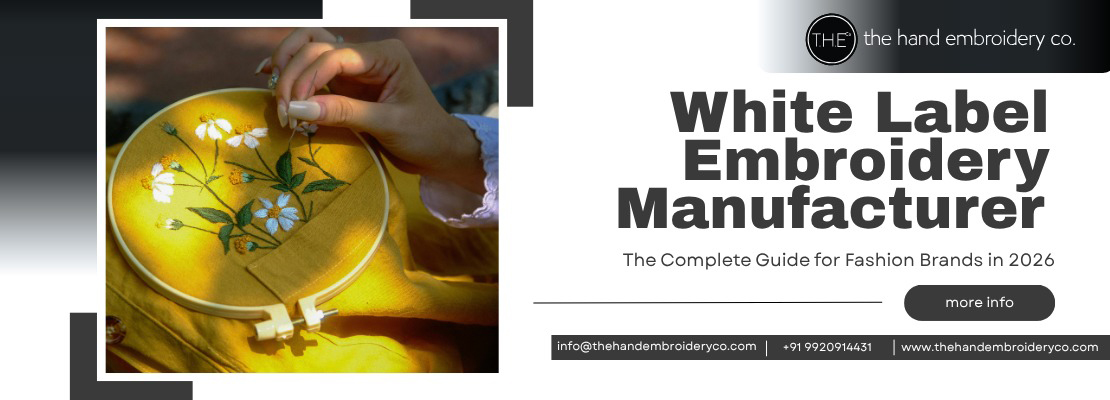
By The Hand Embroidery Co. Team · June 2026 · 22 min read · Manufacturing · B2B Sourcing · Fashion Brands
You have a fashion label. You have designs you believe in — sketches that have lived in your notebook, your Pinterest board, your late-night voice memos to yourself, for months. What you don't have, yet, is a factory, a team of master embroidery artisans, or the operational machinery to turn a sketch into a finished, sellable garment hanging on a rack or photographed for your next product drop.
This is the exact moment every growing fashion brand reaches. It usually arrives quietly — not as a crisis, but as a realisation. You've sold a small first batch, perhaps made entirely by a local tailor or a single artisan you found through a friend. The orders are growing. The quality needs to be more consistent. The next collection needs embroidery work more intricate than what your current setup can handle. And you start asking the question that brings most fashion founders to a guide exactly like this one: how do I find a manufacturing partner who will make my product, under my label, without me owning a factory?
This is what white label embroidery manufacturing means — and it is one of the most consequential sourcing decisions a fashion brand will ever make. Get it wrong, and you'll face inconsistent quality between batches, missed deadlines that cascade into missed launch dates, and in the worst cases, designs that quietly reappear on a competitor's rack six months later. Get it right, and you gain something far more valuable than a single production run: a long-term partner who scales with you, from your first 20-piece capsule collection to your 2,000-piece seasonal flagship drop, without you ever having to think about thread sourcing, artisan training, or factory floor management again.
This guide exists to walk you through exactly what white label embroidery manufacturingis, how the industry's most misunderstood concept — minimum order quantity (MOQ) — actually works, what questions separate a serious manufacturing partner from a risky one, what the entire process looks like from your first sketch to a finished garment in a box ready to ship, and what it actually costs in 2026.
We are The Hand Embroidery Co. (T.H.E. Co.) — a bespoke embroidery export house based in Mumbai, India, with 45 years of combined artisan craftsmanship behind us, more than 5,500 sample swatches produced across every major hand embroidery technique, 155 brands served, and clients across 12 countries. We're going to be straightforward in this guide about both what to look for in a manufacturing partner and what red flags to walk away from — because the fashion industry has enough vague, marketing-driven content about sourcing already, and a founder evaluating manufacturers deserves something more honest than that.
Quick answer, for those who want it immediately: White label embroidery manufacturing is when a fashion brand designs a product, and a manufacturing partner produces it using their own facility, their own trained artisans, and their own equipment — then delivers the finished goods to be sold entirely under the brand's own name, with no manufacturer branding visible anywhere on the final product. The brand owns the design direction and the customer relationship. The manufacturer owns the production process, the quality control, and the craftsmanship that turns a sketch into something a customer will actually want to wear.
Let's go deeper into every part of that definition, because each piece of it matters enormously when you're choosing who to trust with your brand's reputation.
What Does "White Label" Actually Mean in Embroidery Manufacturing?
The phrase "white label" comes originally from the record industry — a "white label" was a blank record sleeve, ready for any distributor to print their own label on top of the pre-made product inside. The concept transferred into manufacturing broadly: a product made by one company, sold under another company's name, with the manufacturing company remaining invisible to the end customer.
In the embroidery and fashion manufacturing world specifically, this means a few different things depending on how a manufacturer operates, and understanding the spectrum matters before you sign anything.
At one end of the spectrum, you have manufacturers who produce a genuinely generic, repeatable product or technique — say, a standard Zardozi border pattern, a commonly requested bead motif, or a stock thread embroidery design — and will sell that exact same design, with no exclusivity, to any brand that orders it. Three different fashion labels might end up selling garments with the identical embroidered pattern, each rebranding it as their own. This is the purest form of "white label" and it works well for brands that want speed, lower cost, and don't need design exclusivity — think of fast-turnaround basics, simple branded merchandise, or accessory lines where the embroidery is a secondary feature rather than the core design statement.
At the other end of the spectrum, you have what the industry more precisely calls private label manufacturing: a manufacturer produces a fully custom design that is exclusive to your brand — built from your own sketches, your specific colour palette, your fabric choice, your sizing specifications — and that design is never sold to, or replicated for, anyone else. This is what most serious, established fashion and bridal brands actually want when they search for a "white label embroidery manufacturer," even though the terminology they use doesn't precisely match what they're describing. They don't want a generic product with their tag sewn on. They want their vision made real by skilled hands, with the certainty that the design will remain theirs alone.
At The Hand Embroidery Co., we operate almost entirely on this private label model. Every design we produce is custom-made to your specific brief, and every design is protected under a strict no-replication, no-resale policy that we apply without exception, regardless of how small or large the client. If you found this guide because you searched "white label embroidery manufacturer" but what you actually need is full design exclusivity and confidence that your work will never appear elsewhere, that protection is exactly what we provide as a foundational part of how we operate, not as an upsell or add-on service.
Why Fashion Brands Choose to White Label Their Embroidery Instead of Building In-House
Before diving further into the mechanics of sourcing, it's worth pausing on why this decision matters so much for a growing fashion brand, because the reasoning shapes how you should evaluate every potential partner.
Capital efficiency.
Building an in-house embroidery capability — training artisans, sourcing specialised equipment for techniques like Zardozi or Tambour work, securing workspace, managing payroll for skilled labour that takes years to develop — requires capital that most growing brands simply don't have, and shouldn't spend, in their early years. Partnering with an established manufacturer means you access decades of accumulated craft expertise without the capital outlay or the multi-year learning curve.
Speed to market.
A new technique, a new collection, a new seasonal drop — all of these move faster when you're working with artisans who have already mastered the relevant embroidery style, rather than training a team from scratch for every new design language you want to explore.
Quality consistency at scale.
A single skilled artisan working alone can produce extraordinary individual pieces, but scaling that same quality across 200 or 2,000 units requires production management infrastructure — sample approval processes, quality control checkpoints, artisan coordination — that most independent designers haven't built and don't need to build themselves when a manufacturing partner already has it.
Risk distribution.
When you white label your production, your manufacturing partner absorbs the operational risk of artisan availability, material sourcing fluctuations, and production scheduling. Your team can focus entirely on design, brand building, and customer relationships — the parts of the business that actually differentiate you in the market.
None of this means in-house production is never the right choice — some luxury houses build extraordinary internal ateliers precisely because the production process itself becomes part of their brand story. But for the overwhelming majority of growing fashion brand, especially in their first several years, a trusted manufacturing partner is the more sustainable and more strategically sound choice.
How Minimum Order Quantity (MOQ) Actually Works — And Why Most Explanations Get It Wrong
MOQ is, without question, the single biggest source of anxiety for small and growing fashion brand evaluating manufacturers — and it is also the most misunderstood concept in the entire sourcing conversation. Most manufacturer websites either avoid the topic entirely or publish a flat number that doesn't reflect how production economics actually work. Here is what genuinely determines MOQ, broken down honestly.
Technique complexity drives MOQ more than anything else
A simple, thread-only border embroidery — say, a clean geometric pattern stitched along a hemline — requires relatively little artisan setup time per piece. The artisan can move from one unit to the next with minimal recalibration. This kind of work tends to have lower, more flexible minimums.
Intricate Zardozi work involving metallic thread, wirework, and dense motif coverage is a completely different proposition. Each piece demands careful, slow, highly skilled handwork, and the artisan's setup — selecting the right gauge of metallic thread, preparing the specific embellishments, working through a complex motif pattern for the first time on your design — takes meaningful time regardless of whether you're ordering one piece or fifty. Manufacturers offset this setup cost with somewhat higher minimums, not because they're being restrictive, but because the economics of highly skilled handwork genuinely require it.
Design exclusivity often lowers MOQ, counter to what people expect
This surprises most first-time buyers: a fully custom, never-before-made design frequently has a lower MOQ requirement than people assume, because the manufacturer isn't trying to recoup tooling or pattern-development costs across a large production run the way a machine-based manufacturer might. In hand embroidery, each piece is made by hand regardless of total order size — there's no expensive die-cut tool or industrial machine setup that only becomes cost-effective at volume. This means bespoke, one-of-a-kind orders are often more achievable at small quantities than people expect when they assume "custom" automatically means "large minimum."
Fabric and material sourcing can raise MOQ for practical reasons
If your design calls for an imported fabric available only in bulk rolls, or a specific rare bead type that needs to be sourced internationally in a minimum purchasable quantity, the manufacturer may set a slightly higher MOQ simply to make the sourcing logistics worthwhile — not as an arbitrary barrier, but as a reflection of how the supply chain for that specific material actually works.
Artisan specialisation creates its own constraints
Certain techniques — particularly the most specialised couture beading styles — are performed by a smaller pool of artisans with that specific expertise. This can mean smaller production batches are genuinely achievable (because you're not trying to coordinate across a large team), but it can also mean meaningful minimum commitments exist to justify the dedicated time of artisans whose skill is in high demand across multiple client projects.
What MOQ actually looks like at The Hand Embroidery Co.
Because we operate as a bespoke, made-to-order export house rather than a mass-production factory, our MOQ depends entirely on the specific design and technique you bring to us — exactly as our website states, though we recognise that single line deserves far more explanation than it typically gets, which is part of why this guide exists. In practice, this means two things. First, a single sample piece is always possible, and is in fact the recommended and standard first step of our process for every client we work with, regardless of their eventual order size. Second, full production runs are scoped individually based on your actual design brief — we look at your technique, your fabric, your design density, and give you a real number, rather than quoting a blanket minimum that doesn't reflect your specific project.
How Much Does Hand Embroidery Manufacturing Actually Cost in 2026?
Cost is the question every serious buyer wants answered before they invest time in a conversation, and it's also the question most manufacturer websites avoid entirely — usually with a vague "contact us for pricing" that leaves a founder no closer to understanding whether a partnership is even financially viable for their brand.
Cost depends on four interacting variables: the embroidery technique itself, the density and complexity of the design, the fabric and material choices, and your order volume. Here is an honest, indicative breakdown for fashion brands sourcing hand embroidery from India in 2026, based on the kind of projects we see across our client base.
| Embroidery Type | Indicative Cost Range (Per Piece, USD) | What Primarily Drives the Price |
|---|---|---|
| Simple thread embroidery (logo, light border work) | $8 – $25 | Stitch count, coverage area, thread type |
| Aari chain-stitch work | $15 – $60 | Design complexity, total coverage |
| Zardozi (metallic thread and wire embroidery) | $40 – $250+ | Metal thread density, motif intricacy, gold/silver-grade materials |
| Beaded and sequin couture embroidery | $60 – $400+ | Bead type and grade, density, total artisan labour hours |
| Full bridal lehenga or gown embroidery | $200 – $2,000+ | Total coverage area, technique mix, embellishment grade, garment construction |
A few important notes on reading this table honestly. These ranges are starting reference points for planning purposes, not fixed quotes — every genuine quote we provide is based on your specific tech pack, your fabric choice, and your design, because two designs that look similar in a brief can require dramatically different artisan time once production actually begins. The most reliable way to get an accurate number for your project is to request a free sample swatch with your specific design; this gives both you and the manufacturer a concrete, shared reference point for discussing real production costs rather than guessing from a general price range.
It's also worth understanding why hand embroidery costs what it does, especially if you're comparing quotes against machine embroidery providers. A single intricate Zardozi motif can take a trained artisan several hours of focused handwork. That time, multiplied across a garment with substantial coverage, is where the cost genuinely comes from — not markup, but labour. Brands that choose hand embroidery are, in a very direct sense, paying for human skill that took years to develop and cannot be replicated by any machine.
8 Questions to Ask Before Choosing a White Label Embroidery Manufacturer
Choosing the wrong manufacturing partner costs more than money. It costs time you can't recover before a launch date, and in serious cases, it costs your brand's design integrity if a manufacturer is careless or dishonest about confidentiality. Ask these eight questions before signing any agreement or sharing your designs with a new manufacturing partner.
1. Will you produce a free or paid sample before committing to full production?
Any reputable manufacturer should offer a sample swatch or sample piece before you commit to a full production run. This isn't a courtesy — it's a fundamental risk-management step that protects both parties. At The Hand Embroidery Co., this is always the first step of our process without exception: we create a free sample swatch using your exact design and your chosen fabric before any production order is placed, so you can see and feel the actual quality before any money changes hands for a full run.
2. How do you protect my design from being copied or resold to other brands?
This is the question most first-time buyers forget to ask, and it is arguably the most important one on this entire list. Designs leaked to competitors, or quietly resold to a different brand without permission, have ended fashion manufacturing relationships and damaged brand reputations in ways that are difficult to recover from. Ask for a written confidentiality commitment, not just a verbal assurance. We never copy, replicate, or share client designs under any circumstance — this principle has been central to how we operate and central to our reputation as a trustworthy export partner across 45 years in this industry.
3. What is your actual MOQ for my specific design — not your general policy?
Don't accept a vague, generic answer here. A serious manufacturer will actually look at your tech pack or design brief and give you a real, specific number based on the technique and complexity involved, rather than reciting a one-size-fits-all minimum that doesn't reflect your actual project.
4. What embroidery techniques do your artisans actually specialise in?
Zardozi, Aari, Tambour, thread work, beading, and sequin work all require meaningfully different skill sets, tools, and training. A manufacturer who simply says "we do embroidery" without specifying technique expertise may not have the specific capability your design requires. Ask directly. Our artisans specialise across Zardozi, Aari, threadwork, beading, and couture stitch techniques, refined and passed down across generations of craftsmanship.
5. What is your production timeline from approved sample to final delivery?
Get a specific, written timeline — not "a few weeks." A manufacturer who can't give you a concrete number based on your technique and order size likely hasn't properly planned their production capacity, which is itself a warning sign about how reliably they'll hit your launch dates.
6. Do you handle pattern-making if I don't have a production-ready pattern yet?
Many small and emerging brands have a strong design sketch but lack a properly production-ready pattern or technical specification. Ask whether the manufacturer's team can create patterns and tech packs in-house from your design vision. Our in-house team creates detailed artwork and patterns from rough design concepts when you don't have one ready, bridging the gap between your creative vision and what a production floor actually needs to execute it correctly.
7. How do you maintain quality consistency across a larger bulk order?
Hand embroidery carries natural, beautiful variation between pieces — that variation is part of its artisanal charm and authenticity. But there's an important difference between that kind of character and genuinely inconsistent quality that would make a customer feel they received a defective product. Ask specifically how the manufacturer manages quality control checkpoints across multiple artisans working on a larger order.
8. Do you ship internationally, and how does that process work?
Confirm international shipping capability explicitly, and ask whether you can use your own logistics account if you already have shipping relationships established. We ship worldwide and partner with multiple international courier services to secure the best available rates for clients — or we coordinate directly with a client's preferred logistics provider if they already have one in place.
The Complete Process — From Your Design to a Finished Product in Your Hands
Understanding exactly how production unfolds helps set accurate expectations and gives you a clear framework for evaluating any manufacturer's process against ours. Here is exactly how it works when you commission The Hand Embroidery Co. as your manufacturing partner.
Step One — Free Sample Swatch
Everything begins with a free sample swatch created using your specific design and your chosen fabric. Our team tests multiple embroidery techniques directly on the swatch so you can physically compare textures, threadwork density, and finishing quality before committing to anything beyond this initial step. This is where you confirm, with your own hands and eyes, that the direction is right before any larger investment.
Step Two — Sourcing
Once you've approved the design and the swatch, we move into sourcing every material the project requires: the main fabric, any lining, and all embroidery raw materials, from threads to beads to metallic wire. We work with trusted, established suppliers specifically to ensure consistency in fabric quality, accurate colour matching, and thread durability across the full production run — consistency that becomes increasingly important the larger your order grows.
Step Three — Pattern Making
If you arrive without a ready-made, production-grade pattern, our in-house experts create detailed artwork and patterns tailored precisely to your design vision. Using accurate size charts and measurements, we ensure every pattern is genuinely production-ready and aligned with your specific garment specifications — this step is what bridges the gap between a creative concept and something a production floor can actually execute with precision.
Step Four — Hand Embroidery
This is where your design genuinely comes to life. Skilled artisans begin translating your approved design into intricate hand embroidery, stitch by stitch, using whichever combination of techniques your design calls for — Zardozi, Aari, threadwork, beading, or others — to capture the full depth and detail of what you envisioned. This hands-on process adds a rich, distinctly artisanal quality that no machine process can replicate, and it's the central reason brands choose hand embroidery in the first place.
Step Five — Stitching and Finishing
Once the embroidery work is complete, your pieces move into our stitching unit, where expert tailors take over construction. Every garment is handled carefully to ensure precise construction and flawless finishing. Whether your order is a single bespoke piece or a substantial bulk run, we maintain consistent sizing, comfort, and fit across every single unit — the result is a finished, custom-made product that looks sharp and feels exactly right when a customer puts it on.
Common Mistakes Fashion Brands Make When Sourcing Embroidery Manufacturing
Beyond the questions to ask, it's worth understanding the mistakes that repeatedly trip up founders new to this kind of sourcing relationship, so you can avoid them entirely.
Skipping the sample stage to save time
Founders under launch-date pressure sometimes try to skip straight to a full production order based on photos or a verbal description alone. This almost always backfires — fabric behaves differently than expected, colours read differently in person than on a screen, and small adjustments that would have been caught in a sample stage instead become expensive problems across an entire production run.
Not getting confidentiality commitments in writing
A friendly conversation and a good feeling about a manufacturer is not the same as a documented confidentiality agreement. Always get design protection commitments in writing before sharing detailed sketches, tech packs, or proprietary design elements.
Assuming all "hand embroidery" claims mean the same level of craftsmanship
Underestimating realistic timelines
Hand embroidery is, by definition, not a fast process — that's precisely what makes it valuable. Brands that build launch timelines around machine-embroidery speed expectations, then apply those same timelines to hand embroidery orders, consistently end up disappointed or forced into rushed compromises that affect quality.
Choosing the cheapest quote without understanding why it's cheaper
A significantly lower quote than competitors usually means something — lower-grade materials, less experienced artisans, or unsustainable pricing that leads to corners being cut during actual production. Understanding why a quote is priced the way it is matters more than the number itself.
Work With The Hand Embroidery Co. as Your Manufacturing Partner
Whether you're launching your very first capsule collection or scaling an already-established label into new markets, The Hand Embroidery Co. brings 45 years of combined artisan craftsmanship, more than 5,500 sample swatches demonstrating proven technique across every major embroidery style, and a track record built with 155 brands across 12 countries. Your design stays entirely yours throughout the relationship — we never replicate or resell client work under any circumstance — and every project begins with a free sample, so you see and feel the actual quality before committing to any order size.
Request your free sample swatch. Share your design or your tech pack — even a rough sketch is enough to start the conversation. We'll guide you through everything else from there.
Email: info@thehandembroideryco.com
WhatsApp T.H.E. Co. directly: +91 9920914431
Explore our process in detail: thehandembroideryco.com/process
Frequently Asked Questions — White Label Embroidery Manufacturing
What is white label embroidery manufacturing?
White label embroidery manufacturing is when a fashion brand commissions a specialist manufacturer to produce embroidered garments or accessories, which are then sold entirely under the brand's own name with no manufacturer branding visible to the end customer. The manufacturer handles every aspect of production — embroidery technique, material sourcing, and finishing — while the brand retains ownership of the design direction and the customer relationship. At The Hand Embroidery Co., this typically functions in practice as private label production: fully custom designs made exclusively for each individual client, never replicated or resold to any other brand under any circumstance.
What is a typical MOQ for hand embroidery manufacturing?
MOQ for hand embroidery manufacturing varies significantly based on technique complexity, design exclusivity, and material sourcing requirements, which means there is no single standard number that applies consistently across the industry. Simple thread embroidery designs often carry lower minimums than intricate Zardozi or beaded couture work, which require considerably more artisan setup time per piece. The Hand Embroidery Co. evaluates MOQ individually for every design brief rather than publishing one blanket minimum, precisely because doing so would misrepresent how differently a thread-only design and a fully beaded couture piece actually behave in production. A single sample piece is always achievable as the first step of working with us, regardless of your eventual order size.
How much does it cost to manufacture hand embroidered garments?
Hand embroidery manufacturing costs range from approximately $8 per piece for simple thread embroidery up to $2,000 or more per piece for full bridal couture embroidery, depending heavily on technique, design density, and material choices. Zardozi metallic thread work typically falls between $40 and $250-plus per piece, while beaded couture embroidery generally ranges from $60 to $400-plus per piece. The most reliable way to get an accurate number for your specific project is to request a free sample swatch using your actual design, which gives both sides a concrete reference point for an honest project-based quote.
How do I find a reliable embroidery manufacturer for my fashion brand?
To find a reliable embroidery manufacturer, start by verifying their design confidentiality policy in writing, requesting a sample before committing to any full production run, confirming their specific technique expertise across the embroidery styles your design actually requires, and checking their track record with international shipping and existing brand partnerships. The Hand Embroidery Co. has served 155-plus brands across 12 countries over 45 years, with a strict, consistently applied policy of never copying or reselling client designs — and we'd encourage you to verify any manufacturer's reputation and design protection commitments before sharing detailed designs with them, regardless of who you ultimately choose to work with.
Can a small or new fashion brand work with an embroidery manufacturer in India?
Yes, and this happens regularly. Many embroidery manufacturers in India, including The Hand Embroidery Co., work productively with small and genuinely emerging fashion brands, not exclusively with already-established labels. The key factor that makes this work well is finding a manufacturer who offers a sample-first process, allowing you to validate quality and fit before committing to volume, combined with transparency about MOQ based specifically on your design rather than insisting on large blanket minimums regardless of project type. Starting with a single sample swatch is the recommended and most common first step for any new brand exploring hand embroidery manufacturing for the first time.
What's the difference between hand embroidery and machine embroidery manufacturing?
Hand embroidery is created entirely by skilled artisans using needle-and-thread techniques such as Zardozi, Aari, and various beading methods, producing unique, deeply textured results where no two pieces are ever perfectly identical — a quality many brands specifically want rather than see as a limitation. Machine embroidery uses digitized patterns run through embroidery machines, producing fast, perfectly consistent results at a meaningfully lower cost per unit, but without the artisanal depth, texture, and one-of-a-kind quality that hand work naturally carries. Luxury fashion, bridal wear, and couture brands typically choose hand embroidery specifically for the craftsmanship value that machine work simply cannot replicate, regardless of how advanced the machine technology becomes. The Hand Embroidery Co. specialises exclusively in hand embroidery for exactly this reason — it's not a service we offer alongside machine work, it's the entire foundation of what we do.
How do I know if a manufacturer will keep my design confidential?
Look for an explicit, written confidentiality commitment rather than relying on a general impression of trustworthiness from a sales conversation. Ask directly how the manufacturer has handled design protection historically, and consider asking for a non-disclosure agreement for particularly sensitive or signature designs. A manufacturer with a long operating history and an established reputation — like 45 years in business — has considerably more to lose from violating client trust than a newer, unproven operation, which is worth factoring into your evaluation alongside any written commitments they provide.
What information do I need to provide to get an accurate manufacturing quote?
To get an accurate quote, provide your design sketch or tech pack, your preferred fabric type, the specific embroidery technique you're envisioning (or ask for a recommendation if you're unsure), your target order quantity, and your desired timeline. The more specific detail you can provide upfront, the more accurate and useful the resulting quote will be — vague briefs tend to produce vague quotes that change significantly once real production planning begins. Requesting a free sample swatch alongside your initial brief is the most effective way to move from a rough estimate to a genuinely accurate, project-specific cost.